
People always tell me I’m good with words. Maybe I am. I don’t know. When I compare myself to other writers, I always admire what they do. And perhaps there are those who compare themselves to me. The comparison game should never be played, at least if we care about our mental health and well-being. Writers write and love words.
Because I love words and creative ideas, I’m always making notes. A unique idea pops into my head, and I play with it until there’s enough for a story. Then I spend my free time writing. Sometimes this takes a month, sometimes a few months. It depends on how much time I can dedicate to the story or the word count.
In the end, I have a finished first draft and it’s… brilliant! I usually read that first draft and think, ‘This is the best thing I’ve written’! I’m thrilled. I’m excited. And I can’t wait to publish.
Welcome to the cooling off period. This is when the book is put aside so I can create some distance between myself and my words. This is needed for the revision and editing stage.
During the revision and editing, the critical cap comes on, and that brilliant first draft loses its sparkle. Suddenly, all excitement is snuffed out, and I’m questioning what I saw in the manuscript. The idea is no longer creative and fun. Somewhere in this time frame, the book goes into hiding. And I’m quite confident it’ll never see the light of day again. I mean, it’s horrible, and how could I ever consider publishing it?
And then I move on to another idea. As I work on the new manuscript, thoughts of the old manuscript are still present. And somewhere along the line, I decide to give it another read. And guess what? The old manuscript doesn’t seem so bad anymore. Sure, it needs work and editing, but it’s actually a good story.
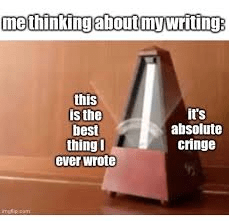
This process has happened with every book I’ve written. And now that I’ve recognized the pattern, I laugh when it happens. The main reason I go through this pattern is due to the ‘hat’ I’m wearing. First, the writer hat. Second, the revision/editor hat. Third, the writer/reader hat. The first and third hats are engaged with the story, so naturally, they are positive. These hats allow me to get lost in the story. The second hat is critical. It focuses on all the errors and mistakes, so of course, it sees the work as ‘no good’. This hat only looks at everything wrong with the story. Hat number three is a balanced hat. It can handle re-writes, revisions, and edits while enjoying the story.
So when people tell me, ‘you have such a way with words’. I appreciate it. And when people claim they can’t write, I share this side of the writing process. After a good laugh, they feel they can write too.
 K. M. Wray